





The Doom of Career and Technical Education · 20 October 2026
The current FutureReady proposal will doom Career and Technical Education (CTE) in the state of Washington, and as a result will cripple both higher education and the workforce in general.
The proposed FutureReady recommendation cuts the current credit of CTE from high school graduation requirements. Perhaps the policy makers are thinking that the Financial Education course will be a CTE course, but it is not mandated as such. Even if it was mandated to be a CTE course, there should still be a full CTE credit beyond this as a requirement.
CTE classes are an important part of every high school student’s education. A friend of mine used to say tongue in cheek that CTE classes are the courses that the other classes are there to support. The grain of truth in his statement is that CTE courses put into practice the foundational material and skills that the academic classes teach. CTE teachers show the students how to apply the other courses to the world of work and give relevance to what students learn in their other high school courses.
I have been the beneficiary of CTE classes in my own education. I took an Architectural Drafting class in high school, which helped me in my college drafting course when I went to the University of Washington to become an engineer.
I have since left the engineering profession to become a CTE educator. I have been a CTE educator for over 30 years and have seen firsthand how not only my students but all CTE students have benefited from CTE classes and, more importantly, CTE teachers.
The CTE students who invest their time in CTE courses and in student leadership through Career and Technical Student Organizations (CTSOs) are the ones who are entering and completing college programs, both two-year and four-year programs. They are the ones completing certificate and apprenticeship programs. They are the ones entering the workforce prepared to do the jobs they are studying and training for. They are the ones becoming productive members of society and helping others to do the same. And they are the ones who will be hurt by the current recommendations of FutureReady if these recommendations are legislated and at least a full credit of CTE courses is not required for high school graduation.
But the damage will be wider spread than to just to those who currently take CTE courses. Indeed, the damage will be greater to those who do not already know the value of CTE courses. For those who are not required to take any CTE courses will not see the relevance of those academic courses they are required to take. The CTE course offerings will dwindle because students are not required to take them, which will mean that even those who want to take these courses will not be able to do so. Some of the students who only go to school to be in those CTE courses will stop attending. And so both higher education and the workforce will be bereft of even more quality candidates than they have today.
Am I overstating the effect of the eliminating the CTE course requirement? Perhaps. But I am not so sure. For it seems to me that CTE is the hidden gem of public education. The only ones who want to get rid of it are those who do not know any better or those who are jealous of its success.
So why has it seemed that the CTE world has been silent on FutureReady? I think it is because the proposal has changed before anybody noticed. The Draft Graduation Framework of July 22, 2026 is not the same as it was in earlier drafts, where CTE was still a graduation requirement instead of an additional nebulous requirement (as it currently stands). No supporter of CTE would look at the current proposal as a benefit to any student.
FutureReady is not ready to be enacted the way it currently stands. A full credit of CTE must continue to be a high school graduation requirement. Students, institutions of higher learning, and the workforce continue to need it to be so.
© 2026 Michael T. Miyoshi
| Share on facebook | Tweet |

|

A Murder of Crows · 17 October 2026
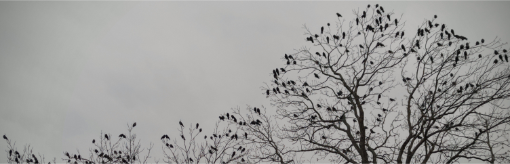
“The Birds. I never should have watched Alfred Hitchcock last night. Now, even the birds sound suspicious.”
Jonathan rolled his eyes. “Ah c’mon, Jessica. How can birds sound suspicious?”
C-caw. C-caw!
“Did you hear that?”
“Yeah. It was a crow. Just a normal crow.” He looked at the gathering of crows. “A lot of crows.”
“And you know what a bunch of crows is, right?” Jessica did not wait. “A murder. A bunch of crows is a murder of crows. A murder!”
“Yeah. I get it, Jessica. Murder.”
Caw. C-c-caw. Caw.
Jonathan looked in the direction of the nearest crow. “Uh… Uh, that was weird. And a little…”
“Suspicious,” Jessica said as she nodded.
“Maybe.”
“And you didn’t even watch the movie!”
Jonathan shook his head. “I’ve never seen it. Ever.”
“But you still think it sounded suspicious.”
Jonathan was non-commital. “Maybe.”
C-c-c-caw. C-c-c-caw. C-c-c-caw!
Jonathan looked at the gathering crows. “All I know is that it’s time to leave.”
Jessica looked up at the gathering crows and nodded as she walked toward the vehicle. “Yeah. Time to go.”
***
The crows watched the vehicle drive out of sight.
“Do you think she’ll watch the movie again tonight, Jackie?”
“Nah. She’s spooked. Just like they all get.”
“Yeah. I know what you mean.”
“That Hitchcock. What a genius!”
“You can say that again.”
“That Hitchcock. What…”
“He didn’t really mean to repeat it.”
“C-c-caw. C-caw. C-c-caw.”
“Caw. C-caw.”
[It was the kind of morning where even the crows sounded suspicious…
DailyPrompt prompt]
© 2026 Michael T. Miyoshi
| Share on facebook | Tweet |
|
Halloween Stories · 10 October 2026
I have written some Halloween stories that I plan to post here on my blog, so I figured I should lay the groundwork first.
I am not a guts and gore type of writer. It is just not how I think. But beware. (The next sentence may be a bit of a spoiler.) One of my stories has a little bit of gore. (Now, back to the rest of the story.)
I wrote the stories that are to come as prompts for DailyPrompt. Which, as I have said before, is a great website (and app) that I use to just have some fun writing. Some different fun. After all, I have great fun writing regardless of whether it is writing this blog or writing a poem or writing a book. I love to write. It is just part of who I am. But there is something about writing to a prompt.
The thing that I like about writing to a prompt is that it forces me to think of stories and poems in a different way. Instead of creating something completely from scratch, I get to start with the seed of an idea. Which is normal, mind you. That is actually how I write. I get an idea or the seed of an idea and the story comes. Not necessarily all at once, but it eventually comes. For instance, I have been writing one story in my head for nearly thirty years. I even wrote the beginning, but it stalled. Now, the ending finally came to me, so I just need to finish writing it. Along with all the other stories that I still need to start, finish, edit, or work on in whatever state it is in.
I treat the DailyPrompt prompts as a challenge. A challenge to create a complete story or complete poem in a sitting. I do not do it every day anymore. (I did for over 100 days, skipping most Sundays, and came out with a book of those stories and poems. Hint hint.) Instead, I pick and choose the ones that I want to write something for. I write a poem about this or short story about that. It is great fun.

Which is how I came to write some stories out of my norm. Maybe even a little out of my comfort zone. They were great fun though. And they might even be okay. You, dear reader (both real and imaginary), get to be the judge of that. You get to determine whether I made the grade or not.
One more thing about DailyPrompt prompts. Not everybody treats them as a challenge to create a full story or complete poem. (Okay, maybe complete poems.) Which is great because the prompts are just there to get people to write something. Nearly anything. But I like to write complete stories because that is who I am. If I am going to respond to a prompt, I am going to finish the story. Even if it is a bit longer than some people are willing to read. After all, I figure that if I am going to make a story public, I may as well make it complete.
I hope you enjoy my Halloween stories. They are not truly Halloween pieces except the last one. The one that will go live on Halloween. But they are creepy enough or scary enough (not too scary though) or at least different enough to be included in a Halloween collection. I hope you enjoy them.
© 2026 Michael T. Miyoshi
| Share on facebook | Tweet |
|
| Older |